5-Step High Ticket Sales Framework Process Workflow to Dominate 2026
Implementing a premium high ticket sales framework is the fastest and most reliable way to build a sustainable, highly profitable consulting business today. For many aspiring digital entrepreneurs, starting an online venture feels like an exhausting uphill battle against an ever-changing algorithm.
The traditional, slow method of web marketing relies heavily on writing hundreds of blog posts, mastering complex search engine optimization, and launching low-priced digital products. This archaic model often takes months or even years to bear any financial fruit. In stark contrast, leveraging a modern high ticket sales framework allows you to bypass the need for a massive audience or a highly complicated tech stack.
By focusing your operational energy on selling high-value, high-end offers—such as one-on-one coaching, premium consulting services, or interactive masterminds—you can generate significant revenue rapidly. This detailed, step-by-step case study workflow will guide you through the exact procedure of implementing a premium high ticket sales framework. You will learn how to launch, test, and scale a highly profitable digital business without overcomplicating your daily operations.
The “Quick Answer” / Key Takeaways Box
- The Volume Myth: You do not need thousands of followers to make money. A high ticket sales framework requires only a handful of qualified leads to generate a full-time income.
- The Squeeze Page: Your only objective is capturing email addresses. Do not build complex websites; build a single page offering a highly specific, valuable free guide.
- The Booking Mechanism: Send the “Help Two People” email campaign to create genuine scarcity and transition email subscribers to live phone consultations.
- The 3-Question Close: Stop using pushy sales tactics. Ask your prospects about their 3-year goal, their current plan, and their biggest obstacles to let them sell themselves.
- The SaaS Upgrade: Automate your lead capture and email follow-up using premium software tools that also provide recurring affiliate commissions.
Why the Slow Classic Model is Dead in 2026
Many web marketers who began their journeys in the early days of the internet spent years perfecting the slow, classic model. This model typically involved writing endless articles, building a massive social media following over several years, and eventually launching a series of inexpensive online courses or $20 e-books.
While this classic approach built stable online businesses in the past, it is now extremely time-consuming and dangerously labor-intensive. It requires a highly diverse skill set, ranging from deep technical SEO knowledge to persuasive copywriting, web design, and advanced sales funnel engineering. When you are starting from scratch, you do not have the luxury of waiting twelve months to make your first sale.
This is precisely why a dedicated high ticket sales framework is the ultimate operational shortcut to entrepreneurial success. By implementing a targeted high ticket sales framework, you focus exclusively on selling premium-priced services directly to a small group of highly qualified leads.
Instead of exhausting yourself trying to sell a $20 e-book to 500 different people, you focus on selling a $2,000 coaching program to just five individuals. This strategic pivot dramatically reduces the amount of web traffic you need to generate. It allows you to establish a deep, transformative connection with your clients while providing immediate cash flow that you can safely reinvest back into your business infrastructure.
[IMAGE PLACEHOLDER: A split screen comparing the math of selling 500 low-ticket ebooks versus 5 high-ticket consulting packages. Alt text: High ticket sales framework revenue comparison math]
Step 1: Identifying a Highly Profitable Niche
The absolute foundation of any successful high ticket sales framework is selecting a market niche where clients are already actively spending money to solve urgent, high-value problems. If you select a niche where people lack disposable income or simply do not perceive their problem as painful, your high-ticket offer will struggle to gain any traction.
To build a robust, scalable offer using this high ticket sales framework, you must align your expertise with one of the primary profitable niches on the internet. According to extensive market research from leading business institutions, the most profitable online niches fall into distinct, evergreen categories. Customers in these spaces are highly motivated to invest in premium solutions.
1. The Wealth and Business Niche
This is arguably the most lucrative area for a high ticket sales framework because the return on investment (ROI) is direct and easily measurable for the client. When you help clients make money or save money, they are highly willing to pay a premium.
Sub-niches include guiding aspiring business owners through the complex process of launching their companies. You can also focus on helping corporate professionals transition into high-paying consulting or freelance roles. Other highly profitable avenues include teaching businesses how to generate leads, optimize digital advertising campaigns, or navigate commercial real estate investments.
2. The Health and Fitness Niche
Health is an invaluable asset, and individuals experiencing physical discomfort or seeking peak performance are highly motivated buyers. If you apply the high ticket sales framework to health, you must focus on specific, intensely painful problems rather than generic fitness advice.
Provide specialized consulting for chronic pain management, such as severe back pain or persistent insomnia. You can offer tailored coaching for sustainable weight loss or create high-end paleo nutrition programs specifically designed for busy, high-net-worth executives. Guiding clients through alternative wellness and holistic lifestyle shifts also commands premium pricing.
3. The Personal Relationships Niche
Human connection, romance, and family dynamics are deeply emotional areas where people actively seek expert guidance. The high ticket sales framework thrives here due to the extremely high emotional stakes involved.
You can coach individuals on how to build unshakable confidence, find a life partner, or navigate complex post-breakup reconciliation. Positive parenting is another massive sub-niche, where you help single parents navigate the challenges of adolescence. Training corporate professionals on non-verbal communication and high-value networking also fits perfectly into this framework.
4. High-Value Skills and Hobbies
People are consistently willing to invest heavily in mastering complex skills or participating in premium hobbies. In this category, your high ticket sales framework can target deep, specialized knowledge acquisition.
Offer high-end programs on executive public speaking, direct-response copywriting, or advanced software programming. You can also provide deep-dive training in professional photography, learning complex languages, or mastering premium sports like golf and equestrianism.
Remember that the high ticket sales framework does not require you to be the world’s leading academic authority. You simply need to be a few steps ahead of your target clients, possess a highly structured plan to help them achieve their specific goals, and be relentlessly committed to delivering massive value.
[EXTERNAL LINK: The Ultimate Guide to Finding Your Profitable Business Niche]
Step 2: Building Your Core Asset—The Squeeze Page Funnel
Once you have identified your profitable niche, the next step in the high ticket sales framework is to establish your core marketing asset: a dedicated email list. Many beginner entrepreneurs make the catastrophic mistake of building their entire audience on rented third-party social media platforms.
While these visual platforms are excellent for generating initial top-of-funnel awareness, relying on them as your primary business foundation is highly risky. If a social media platform suddenly changes its algorithm, reduces your organic reach, or shuts down your account for a policy violation, you can lose your entire source of leads overnight.
This is why a highly resilient high ticket sales framework must prioritize absolute independence. By building an email list, you create a digital asset that you own entirely. No external corporation or algorithmic shift can ever take your email list away from you.
To build this list, you must create a simple, high-converting squeeze page. A squeeze page is a minimalist lead generation asset designed specifically to support your high ticket sales framework. It is a web page designed with a single, uncompromising objective: to capture a visitor’s email address in exchange for a valuable lead magnet.
Designing the Perfect Squeeze Page
An optimized squeeze page within a high ticket sales framework should be entirely devoid of distractions, navigation menus, or external links. It must contain the following core elements:
- A Compelling Headline: Clearly state the primary benefit the visitor will receive. Focus on a highly desired outcome or a rapid solution to a painful obstacle.
- A Free Guide or Lead Magnet: Offer a short, highly practical PDF guide, checklist, or template that solves a specific problem within your niche. For example, your lead magnet could be “The 15-Minute Home Workout Blueprint for Busy Executives.”
- A Simple Opt-In Form: Ask only for their primary email address. Do not ask for their phone number or last name at this stage to minimize friction and maximize conversion rates.
- Clear Call to Action (CTA): A prominent, contrasting button prompting them to download the free resource instantly.
To ensure your squeeze page is technically seamless, you should host it using a reliable marketing platform. Once a visitor inputs their email address to download your free guide, they are officially added to your proprietary email list. Now, you have a direct, reliable line of communication to build trust, deliver value, and introduce them to your premium high ticket sales framework.
Step 3: Launching the “Help Two People” Booking Campaign
With your squeeze page live and your email list slowly growing, you now possess a direct, uncluttered channel to your target audience. The next critical phase of the high ticket sales framework is to bridge the gap between passive email subscribers and live, high-value conversations.
Many marketers drastically overcomplicate this transition by building massive, automated 30-day email sequences that pitch products prematurely. A far more effective and human-centric approach is to launch a simple, high-impact email campaign. This campaign is designed explicitly to get qualified prospects on the phone to experience your high ticket sales framework first-hand.
The core mechanism of this campaign is the “Help Two People” strategy. Once an individual opts in to download your free guide, they have already demonstrated an active, undeniable interest in your niche. Shortly after they consume the guide, you should send a highly personalized follow-up email.
This specific email is purposely designed to be short, casual, and highly personal. It must mimic a raw text email you would send to a close friend or colleague, stripping away all corporate branding and HTML formatting.
The Exact Booking Email Template
Here is the precise structure of the plain-text email you should send as part of your high ticket sales framework:
Subject: Quick question about your goals…
Hey [First Name],
I hope you found the free guide helpful!
This week, I have set aside some time in my schedule to get on the phone with exactly two people to help them personally map out their goals and figure out the absolute best way to get there.
If you’re interested in grabbing one of these two spots, just hit reply to this email and let me know a little bit about what you’re working on.
Talk soon!
This email is incredibly powerful because it relies on genuine scarcity and the offer of direct personal assistance. By limiting the offer to just “two people,” you instantly create urgency and highlight the exclusive nature of your high-ticket service. Because it is written in a casual, conversational tone, it drastically lowers the reader’s defense mechanisms and encourages them to hit reply.
When a subscriber replies to your email, do not immediately try to sell them a coaching program. Instead, use this opportunity to start a natural, friendly conversation via email. Ask them a few brief questions about their current situation, acknowledge their challenges, and then transition smoothly to booking a call.
Simply state: “It sounds like you have some great goals, but a few things are holding you back. Let’s jump on a quick call this week to map out a clear plan for you. Here is a link to my calendar.” By using this booking strategy, you fill your calendar with highly motivated prospects who are eager to speak with you. This conversational onboarding is a fundamental pillar of the high ticket sales framework.
[INTERNAL LINK: The Ultimate Guide to Email Copywriting for High-Ticket Offers]
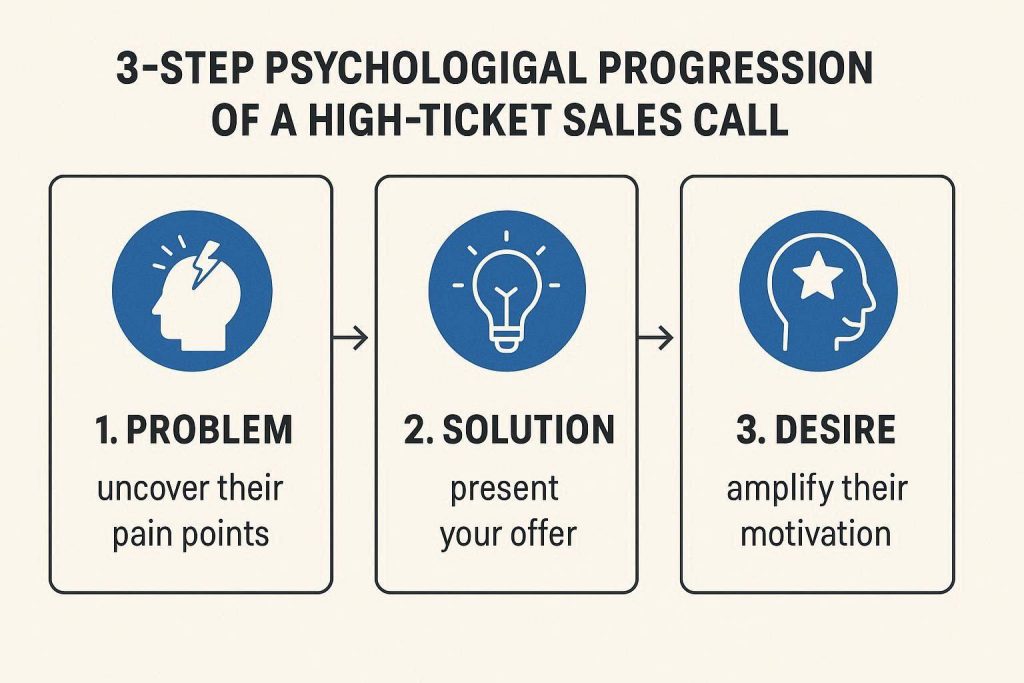
Step 4: Executing the 3-Question High-Ticket Sales Script
Once a prospect is finally on the phone, the true operational power of your high ticket sales framework comes to life. Many people absolutely dread sales calls because they associate sales with pushy tactics, manipulation, and high-pressure, uncomfortable closes.
However, a professional high ticket sales framework completely flips this aggressive dynamic. On a high-ticket call, your goal is never to “convince” anyone to buy anything. Instead, your goal is to deliver immense, undeniable value by helping the prospect clearly define their goals, structure a plan, and identify their fatal obstacles.
The structure of the call relies on an elegant, three-question sales script that is both simple to memorize and deeply psychological. By rigorously following this script, you guide the prospect through a self-discovery process where they naturally sell themselves on the absolute necessity of your premium solution.
The Psychology of Active Listening
Before diving into the actual questions, you must adopt the proper consultative mindset. As a high-ticket consultant executing a high ticket sales framework, your job is to listen intently and keep quiet. You must be 100% focused on what the prospect is saying, remaining completely present and taking highly detailed notes.
Write down their exact answers, paying close attention to specific words and expressions that carry strong emotional weight. To build deep subconscious rapport and show that you truly understand them, follow the golden rule of active listening. After the prospect answers a question, repeat their key points back to them in their exact words, and then ask, “Is that all?”
This incredibly simple follow-up encourages them to go much deeper. It forces them to reveal the true underlying motivations and painful points that they usually keep hidden from strangers. Let us explore the three core questions of the high ticket sales framework sales script.
Question 1: Define the Goal
“If we were to have this conversation exactly three years from now, what needs to have happened in both your professional and personal life for you to feel completely happy?”
This question is a masterclass in psychological future pacing. It completely bypasses immediate, superficial desires and forces the prospect to paint a vivid, emotional picture of their ideal future. By prompting them to consider both their professional and personal lives, you encourage them to connect their business or health goals with their deepest personal values. Write down their answers meticulously, as this represents their ultimate emotional destination.
Question 2: Define the Plan
“What steps do you think you need to take in order to reach those goals?”
This question shifts the focus from the destination back to the journey. It asks the prospect to articulate their own internal strategy for success. Interestingly, most prospects will attempt to lay out a reasonable high-level plan. In doing so, they will suddenly realize the sheer scale, difficulty, and complexity of the task ahead. It helps them structure their thoughts while simultaneously highlighting the massive gap between where they are now and where they want to be.
Question 3: Assess Obstacles and Transition
“What are the specific obstacles that could prevent you from reaching your goals?”
This is the most critical question of the entire high ticket sales framework. It brings the prospect face-to-face with harsh reality. They will begin to list their intense fears, their lack of technical knowledge, their past failures, or their lack of daily accountability.
These obstacles represent the primary reasons they have not achieved their goals on their own. By articulating these obstacles out loud, the prospect is implicitly stating exactly what they need help with.
The Elegant Close
Once the prospect has answered the third question, you repeat their answers back to them, and confirm there is nothing else. You have now reached the transition point. If, and only if, you feel you can genuinely help this person overcome those exact obstacles and achieve their three-year goals, you make them an offer.
If you feel you cannot help them, you do not make an offer. This is an ethical imperative that preserves the strict integrity of your business. However, do not use this as an excuse to avoid making offers out of a fear of rejection. If you can help them, it is your absolute duty to present your premium program as the necessary bridge connecting their current obstacles to their goals.
The transition is smooth and highly natural: “Based on what you’ve shared, I know exactly how to help you overcome these specific obstacles and achieve your 3-year goal. I have a premium coaching program designed specifically to do this. Would you like to hear how it works?”
If they say yes, you clearly describe your offer, explain how it directly addresses their listed obstacles, and state your premium price with absolute confidence. By executing this high ticket sales framework on every call, you remove the pressure of selling entirely.
Required High-Quality SaaS Tools
To execute this high ticket sales framework flawlessly without spending your entire day doing manual admin work, you must utilize a premium technology stack. Relying on free, disjointed software will severely damage your premium brand perception.
1. Funnel and CRM Automation (via PartnerStack) You must build your squeeze pages and manage your lead pipelines using professional-grade software. Platforms like GoHighLevel or Systeme.io allow you to host your landing pages, manage your calendar bookings, and track your pipeline in one place. Accessing these through B2B affiliate networks like PartnerStack allows you to manage your infrastructure professionally while opening doors for future affiliate monetization.
2. Premium Email Deliverability (via Impact) Your “Help Two People” email campaign must actually reach the primary inbox, not the spam folder. Utilizing a premium sender like Kit (formerly ConvertKit) ensures your plain-text emails bypass aggressive spam filters. You can also automate the tagging system so that anyone who books a call is automatically removed from future marketing broadcasts.
3. Frictionless Payment Processing When a client says “yes” on the phone, you must be able to take their payment immediately while their emotional state is high. Utilize Stripe or Payhip to generate instant, secure checkout links that you can drop directly into the Zoom chat or email thread before the call ends.
Step 5: Embracing Imperfection and Stacking Affiliate Income
The final stage of mastering the high ticket sales framework is entirely psychological: you must embrace imperfection and commit to taking massive, immediate action. Many aspiring digital entrepreneurs never launch because they are paralyzed by the pursuit of absolute perfection.
They spend months designing the perfect corporate logo, tweaking the perfect squeeze page, or endlessly refining their coaching offer, only to realize that the market has moved on. In the digital business landscape, raw speed and action trump perfection every single time. If your marketing funnels are perfect before you launch, it means you took far too long to launch. You must move fast, deploy your high ticket sales framework, and get real-world feedback from live prospects. Fail fast, learn what works, and iterate immediately.
The 80/20 Rule of Product Launches
To maintain a healthy perspective on your entrepreneurial journey, keep the 80/20 principle of product launches in mind. When you launch ten different offers or marketing campaigns over your career, a highly predictable pattern emerges.
Two of them will do phenomenally well; they will resonate perfectly with the market and become highly profitable. Two of them will completely bomb and fail to gain any traction whatsoever. The remaining six will perform averagely, making some sales but not becoming massive home runs. This distribution proves that high-ticket success is a numbers game. You must launch quickly and frequently.
Stacking Affiliate Revenue
While your primary focus should always be on signing premium clients for your own consulting offers, a mature high ticket sales framework should be augmented with passive income streams. One of the most effective ways to do this is by promoting the high-quality software tools that your clients already need to run their businesses.
Look for SaaS affiliate programs that offer strong tracking and lifetime recurring commissions. By recommending the very marketing software, CRM systems, and squeeze page builders you use to run your own business, you earn a commission each time your client pays their subscription. This adds a highly stable, predictable layer of monthly recurring revenue on top of your massive high-ticket sales injections.
Strategic Critique: Stress-Testing the Concept
What are the problems with this idea that we are not seeing?
The primary unseen problem with the high ticket sales framework is the immense psychological toll of calendar exhaustion and rejection. While the 3-question script is elegant, a beginner will likely face a 70% to 80% rejection rate on their first 30 calls. Hearing “no” repeatedly on 45-minute Zoom calls is highly demoralizing and leads to rapid burnout. Additionally, the strategy assumes you can generate qualified traffic to your squeeze page for free. In reality, unless you already have a warm audience, driving cold traffic to a squeeze page usually requires highly optimized paid ads, which can drain a beginner’s budget before they ever book their first call.
What assumptions are we making that might not be true?
We are making a massive assumption that prospects will actually show up to the phone call. The “no-show” rate for free discovery calls is notoriously high in the coaching industry (often hovering around 40-50%). If a prospect downloads a free PDF and gets an email, they are still fundamentally “cold.” We assume that a simple, friendly email is enough to build the requisite trust required for them to dedicate an hour of their day to a stranger. In reality, a much longer nurturing sequence or a high-value video sales letter (VSL) is usually required to warm up cold traffic before they will commit to a calendar booking.
If this idea failed, what would be the most likely reason?
If this business model failed, it would most likely be due to a failure in delivering the actual transformation. It is entirely possible to master the sales script, close a client for $3,000, and collect the cash. However, if your premium coaching program lacks structure, accountability, and real-world utility, the client will fail to achieve their 3-year goal. This leads to immediate chargebacks, devastating public reviews, and the total destruction of your brand’s reputation. The high ticket sales framework fails violently if the product fulfillment cannot match the quality of the sales pitch.